

Let me ask you a question: Where is your phone right now?
Odds are, it’s either in your hand, in your pocket, or sitting on the desk right next to your coffee. For most of us, that little piece of glass and aluminum is our entire life. It’s how we check work emails, manage bank accounts, and stay in touch with our team.
Now, imagine if that phone was actually a double agent.
Imagine if every word you spoke in a "private" meeting, every photo you took of a sensitive document, and every password you typed was being beamed directly to a server halfway across the world.
It sounds like a plot from a spy movie, right? But as of March 2026, for many small business owners, this is becoming a very real reality.
At Platinum Web Services, we keep a constant eye on the latest CISA advisories. Usually, these reports are filled with technical jargon that would put a caffeinated IT director to sleep. But this month, the alerts are hitting closer to home than usual.
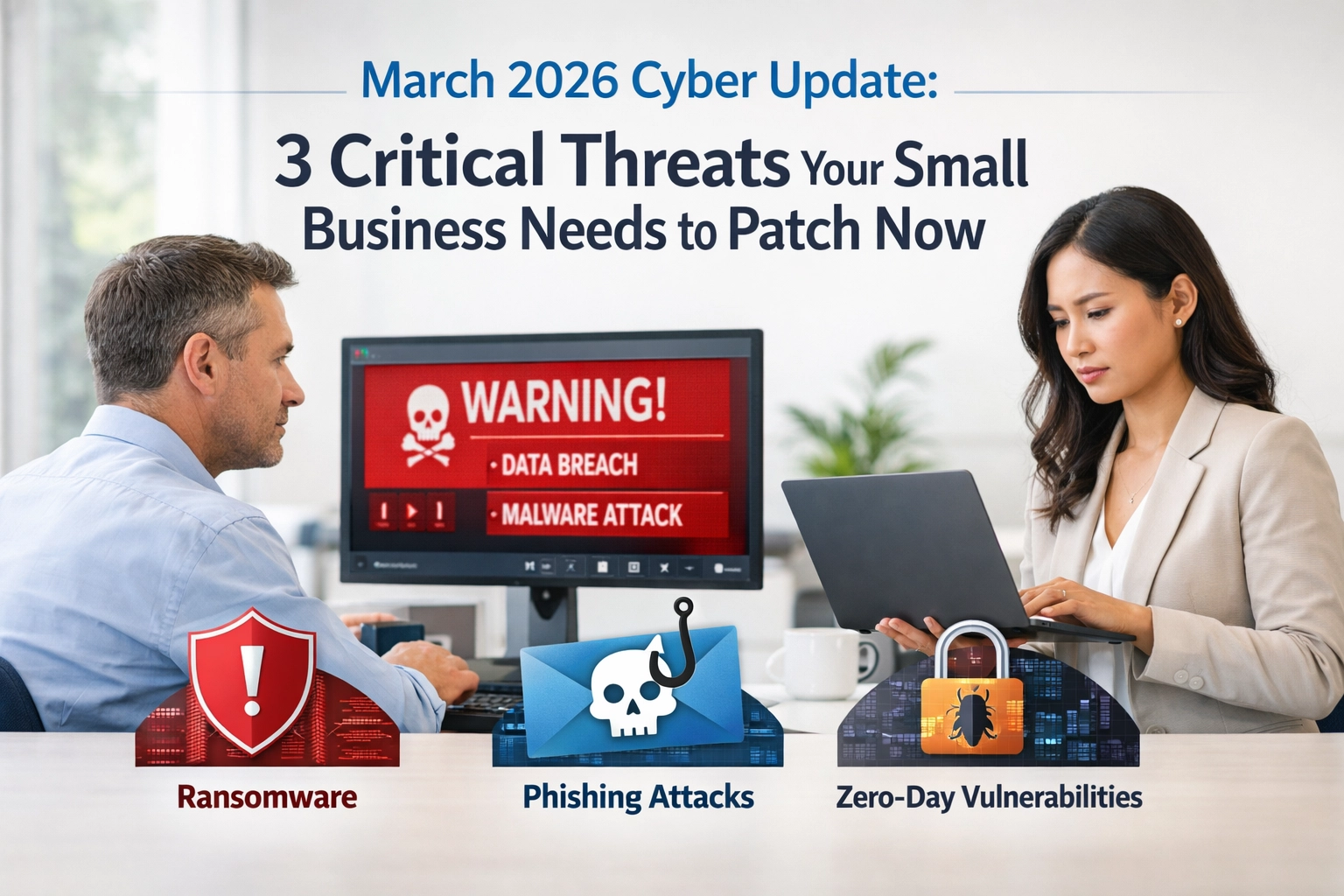
Here are the three critical threats you need to know about right now: and more importantly, what you can do to protect your business.
1. The "Coruna" Spyware: Your iPhone is Listening
For years, we’ve told ourselves that iPhones are the "gold standard" of security. While they are great, they aren't invincible.
CISA recently issued an urgent alert regarding a new strain of spyware dubbed "Coruna." This isn't your run-of-the-mill "click this link to win a gift card" scam. This is what’s known as a "zero-click" exploit.
Here’s why that’s terrifying:
You don’t have to click a suspicious link. You don’t have to download a weird attachment. Your phone just has to receive a specifically crafted message: often through a standard app: and the spyware installs itself in the background.
Once it’s in, it has "God Mode" access to your device. It can turn on your microphone, access your camera, and scrape your encrypted messages.
Think about the last time you discussed a big client contract or a new business strategy near your phone. If you haven't patched this, that conversation might not have been as private as you thought.

What you need to do:
Update your iOS devices immediately. Apple has released a critical security patch specifically to kill the Coruna exploit. If you or your employees use personal iPhones for work (the classic "Bring Your Own Device" or BYOD setup), this is a massive hole in your cyber security solutions for small business.
It only takes one unpatched phone to compromise your entire company’s data.
2. The Windows Notepad Flaw (CVE-2026-15556)
If I told you that a hacker could take over your entire laptop using Notepad, would you believe me?
It sounds ridiculous. Notepad is the simplest, most "boring" app on Windows. It’s just for jotting down quick notes or stripping formatting from a piece of text. But that’s exactly why it’s dangerous. Hackers love attacking the things we trust the most because we never think to look there.
CISA has identified a flaw officially called CVE-2026-15556. In plain English? It’s a "Remote Code Execution" vulnerability.
Here’s the scenario:
You receive a text file via email. It looks like a standard .txt file: something that should be completely harmless. But when you open it in Notepad, a hidden piece of malicious code triggers a "buffer overflow." Suddenly, the attacker has the same permissions on your computer that you do.
If you’re an admin, they’re an admin. They can install ransomware, steal your customer database, or delete your backups.
It’s a reminder that in 2026, no app is too small to be a target. This is why managed IT services are so vital; we catch these "silent" vulnerabilities before they turn into a 2:00 AM emergency call.
3. The "Big Three" are Evolving
While the Coruna spyware and the Notepad flaw are the "new" headlines, the old favorites are still doing record-breaking damage. Research shows that small businesses remain the primary target for three main reasons: Phishing, Ransomware, and Credential Theft.
Phishing and AI Social Engineering
Phishing (pronounced "fishing") used to be easy to spot. You’d look for the bad grammar or the weird sender address.
Not anymore.
With modern AI tools, attackers can now generate emails that look exactly like they came from your bank, your vendor, or even your own business partner. They use your public LinkedIn profile to personalize the message so perfectly that it’s almost impossible to tell it’s a fake.
In fact, Business Email Compromise (BEC) caused over $2.9 billion in losses last year alone. That's not just "big corporation" money; that's small business survival money.

Ransomware Protection
Ransomware is no longer just about locking your files and asking for Bitcoin. The new trend is "Double Extortion."
First, they encrypt your data so you can't work. Then, they threaten to leak your private customer data on the internet if you don't pay up. Even if you have backups (which you definitely should!), the threat of a public data leak can destroy your reputation.
Effective ransomware protection requires more than just an antivirus program; it requires a strategy that includes automated daily backups and system recovery plans that don't involve paying criminals.
Credential Theft
The truth is, most hackers don't "break in": they log in.
If your employees are reusing the same password for their Netflix account and their work email, you’re essentially leaving your front door wide open with a "Welcome" mat. Once an attacker gets one password, they use "credential stuffing" to try that same password on every other site they can find.
So, what can you do?
I know, it sounds like a lot. It’s easy to feel overwhelmed and just want to close your laptop and go for a walk. But you don't have to do everything at once.
Here’s where to start:
- Enforce MFA on everything. Multi-factor authentication (MFA) is that annoying text code or app notification you get when you log in. It might take an extra five seconds, but studies show it blocks over 99% of credential-based attacks.
- Update your "small" apps. Don't just wait for the big Windows updates. Make sure things like Notepad, your browser, and your PDF readers are updated.
- The "Mom Test" for emails. Tell your team: if an email asks for money, a password, or a quick "favor," call the person on the phone to verify it. If it’s actually urgent, they’ll pick up.
- Check your backups. A backup is only as good as your ability to restore it. If you haven't tested your restoration process in the last six months, you don't have a backup: you have a wish.

We’re here to help
At Platinum Web Services, we believe that security shouldn't be a source of constant stress for business owners. You have enough on your plate running a company; you shouldn't have to stay up at night worrying about CISA advisories or buffer overflows in Notepad.
We help businesses like yours by acting as a proactive shield. We handle the managed updates, the security audits, and the 24/7 monitoring so you can focus on what you do best.
Is your business actually protected?
If you aren’t sure whether your team is patched against the Coruna spyware or if your current backups could survive a ransomware attack, let's talk. We can perform a comprehensive security audit to find the holes before the bad actors do.
Don't wait for a "we’ve been hacked" notification to take action. Contact Platinum Web Services today and let’s make sure your business stays your business.
Remember, it’s not about being perfect; it’s about being prepared.
Let’s get those patches installed. Your phone: and your peace of mind( will thank you.)
0 Comments