

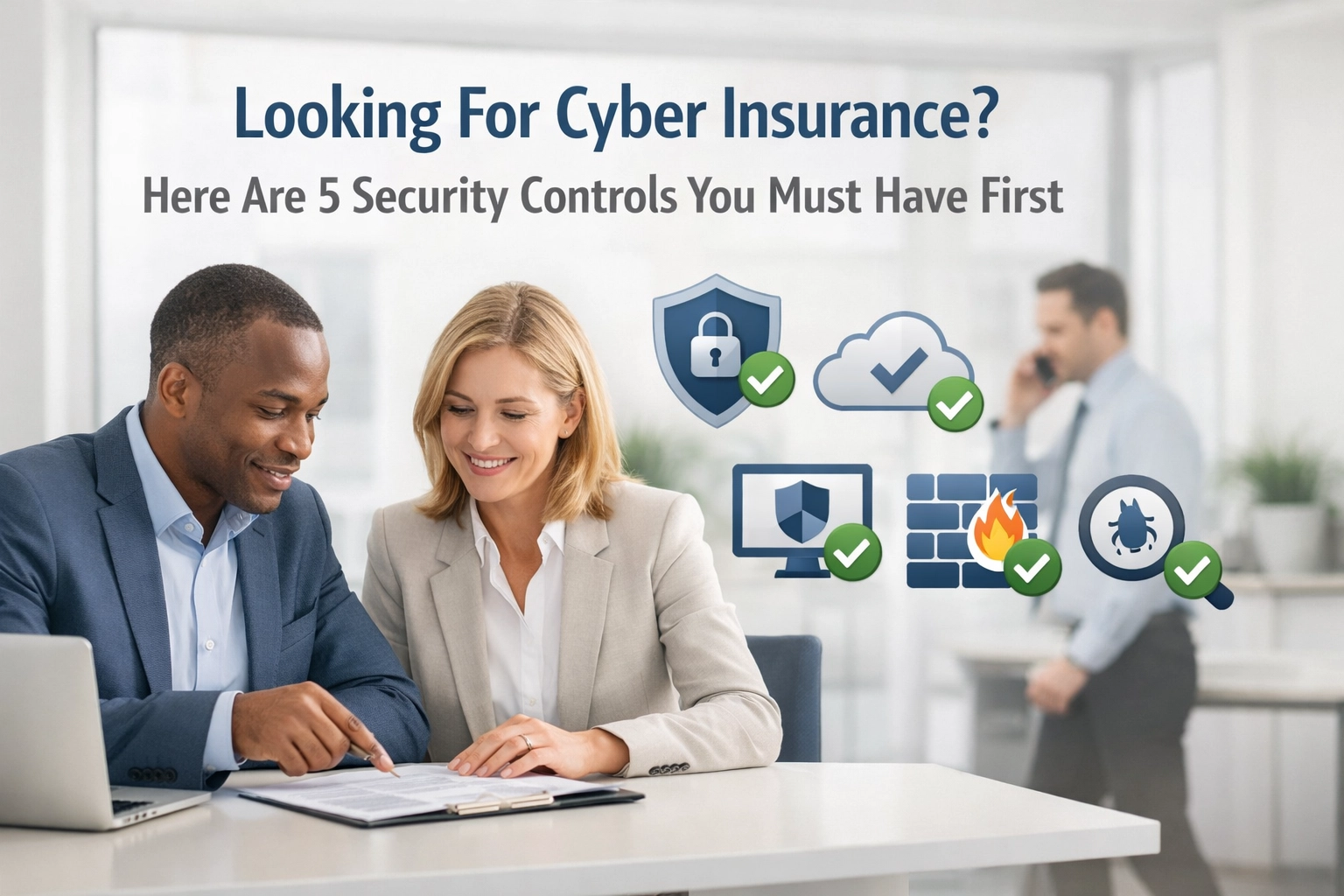
You’re sitting at your desk, coffee in hand, staring at a twenty-page application for cyber insurance.
You thought it would be a simple "yes/no" form, right? Something like: Do you have a computer? Yes. Do you want insurance? Yes.
But as you scroll down, you realize the questions are getting intense. They’re asking about "entropy," "immutable backups," and "EDR."
Suddenly, it feels like you're taking a mid-term exam for a class you never attended.
Let me ask you something: Have you noticed that getting cyber insurance feels a lot harder than it used to be?
It’s not just your imagination. A few years ago, insurers were handing out policies like candy at a parade. Today? They’re acting like the world’s pickiest bouncers at an exclusive club.
If you don't have your "security house" in order, they aren't just going to charge you more. They might flat-out refuse to let you in.
The truth is, insurance companies are tired of paying out massive ransomware claims. They want to know: before they sign on the dotted line: that you aren't leaving your digital front door wide open with a "Welcome" mat out front.
At Platinum Web Services, we see this every day. We help small businesses navigate these technical hurdles so they can actually get covered without losing their minds (or their life savings).
So, before you hit "submit" on that application, let’s talk about the "Big 5" security controls you absolutely must have first.
1. Multi-Factor Authentication (MFA): The Double-Lock Rule
Imagine you have a high-security safe in your office. Would you protect it with a simple four-digit code that anyone could guess?
Of course you wouldn't. You’d want a key and a code. Maybe a fingerprint, too.
Multi-Factor Authentication (MFA) is exactly that for your digital life. It’s the process where you need two or more pieces of evidence to prove you are who you say you are. Usually, it’s your password plus a code sent to your phone or an app.

Here’s the deal: Insurers now consider MFA "non-negotiable."
If you aren't using MFA for your email, your remote access (VPN), and your administrative accounts, your application is likely headed for the shredder.
Why? Because research shows that MFA can block over 99% of account compromise attacks.
It’s the single most effective thing you can do to protect your business. If you’re looking to beef up your email security, this is where you start.
Think about it this way: passwords are like paper locks. MFA is the steel bar behind the door.
2. Regular, Reliable Backups: Your "Get Out of Jail Free" Card
Imagine waking up on a Monday morning to find all your files encrypted. Your client list? Gone. Your invoices? Locked. Your sanity? Hanging by a thread.
This is the reality of a ransomware attack.
In the old days, a backup was just a dusty hard drive plugged into a server. Not anymore.
Insurers want to see that you have a "3-2-1" backup strategy:
- 3 copies of your data.
- 2 different types of media.
- 1 copy stored offsite (in the cloud).
And here’s where it gets scary: modern ransomware specifically looks for your backups and tries to delete them first.
If your backups are connected to your main network without any protection, they’re sitting ducks. Insurers are now looking for "immutable" backups: backups that cannot be changed or deleted for a set period, even by an admin.
It makes sense. If you can’t prove you can recover your data without paying a million-dollar ransom, why would an insurance company want to take the risk?
Check out our Security Hub to see how we handle data protection for businesses like yours.
3. Endpoint Detection and Response (EDR): The Security Guard That Never Sleeps
For years, we all got by with basic antivirus software. It sat in the corner, scanned for known "bad files," and occasionally popped up to tell you it updated.
But hackers got smarter. They stopped using files and started using "fileless" attacks that basic antivirus can't see.
Enter EDR (Endpoint Detection and Response).
Think of basic antivirus like a "Most Wanted" poster at the post office. It only recognizes criminals it has seen before.
EDR, on the other hand, is like a high-tech security guard with a heat-sensing camera and a direct line to the police. It doesn't just look for "bad files"; it looks for "bad behavior."

If a computer suddenly starts trying to encrypt thousands of files at 3:00 AM, EDR says, "Whoa there, buddy," and shuts it down instantly.
And here's a shocker: roughly 65% of insurers now require EDR tools to monitor your systems in real-time. If you’re still running the free antivirus that came with your PC, you’re going to have a hard time getting covered.
4. Patch Management: Fixing the Leaky Roof
You know those annoying "Update Available" pop-ups on your computer? The ones you’ve been clicking "Remind me tomorrow" on for three weeks?
Stop doing that. Right now.
Hackers love "vulnerabilities": which is just a fancy word for a hole in a software's armor. When a company like Microsoft or Adobe finds a hole, they release a "patch" to fix it.
If you don't apply that patch, that hole stays open.
Insurers want to see a documented process for "Patch Management." They want to know that when a critical security hole is found, you’re fixing it within days, not months.
It’s like owning a building. If you have a hole in the roof and you refuse to fix it, don't be surprised when the insurance company refuses to pay for the water damage after a storm.
If you’re feeling overwhelmed by the constant stream of updates, our managed services can take that weight off your shoulders. We handle the patching so you can handle your business.
5. Employee Training: Strengthening the "Human Firewall"
You can spend a million dollars on the best tech in the world, but all it takes is one tired employee clicking on a "Tracking Link" in a fake FedEx email to bring the whole thing crashing down.
Phishing (pronounced "fishing") is still the #1 way hackers get into small businesses.
Most people don't break the rules on purpose. They’re just busy. They’re trying to get through their inbox. They’re human.
That’s why insurers want to see that you are providing regular security awareness training.

It’s not about a boring two-hour lecture once a year. It’s about short, engaging bits of info that keep security top-of-mind.
The goal is to turn your team from your "weakest link" into your "first line of defense." When an employee spots a weird email and reports it instead of clicking it, that’s a massive win for your business: and your insurance premium.
Why the "Who" Matters
Here’s something most people don't realize: the company you choose to help you with your IT matters to your insurance company.
At Platinum Web Services, we aren't just a couple of "tech guys" working out of a garage. We are a Licensed and Insured IT provider.
Why does that matter to you?
Because it gives you (and your insurer) peace of mind. It means we hold ourselves to the same high standards that the insurance companies are asking of you. When we say we’ve implemented these controls, we have the professional backing to prove it.
We don't just "fix computers." We protect livelihoods.
Implementing the "Big 5" controls isn't just about checking boxes on a form to get a lower premium (though that’s a nice perk). It’s about making sure that when you close your laptop at the end of the day, your business is still going to be there in the morning.
So, what can you do?
The world of cyber security moves fast. If you're feeling a bit lost or if that insurance application is currently sitting on your desk mocking you, don't sweat it.
You don't have to do this alone.
Start by taking a look at our 30-minute consultation. We can sit down, look at your current setup, and figure out exactly what you need to get your business "insurance-ready."
Whether you need help setting up MFA, securing your backups, or training your team, we've got your back.
Let's turn your technology from a source of stress into a "Fort Knox" level of security.

Ready to get started? Check out our Contact Page or sign up for our newsletter to stay ahead of the latest threats.
The truth is, the best time to secure your business was yesterday. The second best time is right now.
Give us a call. Let’s tackle your technology together.
Platinum Web Services is a Licensed and Insured IT Services and Technology Consulting firm dedicated to protecting small businesses. For more information on our commitment to your safety, feel free to review our Bill of Rights.
0 Comments