

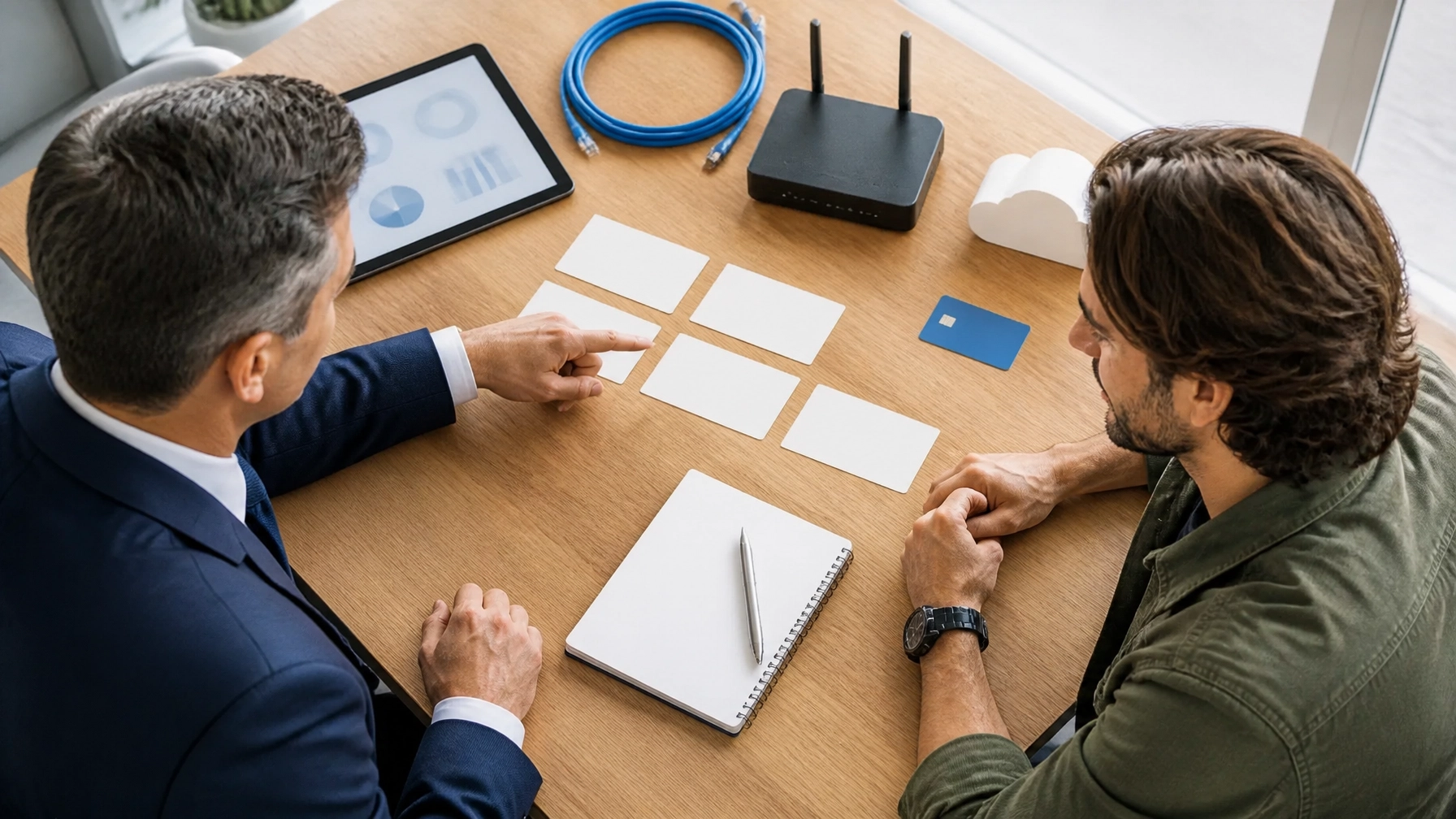
Let me ask you something: If your business suddenly lost access to email, files, customer records, or accounting software, would you know exactly what to do?
You might have a backup. You might have antivirus installed. You might even have someone you call when a computer stops working.
But a pile of technology tools is not the same as a plan.
That is where IT consulting services can help. The right consultant looks at how your business works, where technology is creating risk or slowing you down, and what needs to happen next.
For small businesses in St. Louis, St. Charles County, Chesterfield, Clayton, O’Fallon, the Metro East, and across Missouri, the goal is simple: technology that supports growth instead of becoming another burden.
What IT Consulting Services Actually Include
Many business owners hear “IT consulting” and imagine a technician repairing a laptop. That may be part of the relationship, but it is not the whole picture.
IT consulting services are designed to help you make smarter technology decisions, reduce risk, and build a more reliable foundation for your business in St. Louis and throughout Missouri.
Here are some of the areas a strong consultant may cover:
- Technology assessments: Review your devices, network, cloud applications, security controls, backups, and current weaknesses.
- IT strategy and roadmaps: Create a practical plan for the next 12 to 36 months, including priorities, timelines, and estimated costs.
- Network design: Improve Wi-Fi, routers, switches, firewalls, and connectivity so your team can work reliably.
- Cloud planning and migration: Move files, email, applications, or other systems to cloud platforms in a controlled way.
- Cybersecurity consulting: Strengthen passwords, multi-factor authentication, endpoint protection, email security, access controls, and monitoring.
- Backup and disaster recovery: Design a way to restore important systems and data after hardware failure, ransomware, or another disruption.
- Vendor and software guidance: Help you compare tools, licensing plans, and technology vendors before you spend money.
- Policy and employee guidance: Establish sensible rules for devices, remote work, passwords, access, and security awareness.
At Platinum Web Services, we approach consulting as a conversation about your business first and your technology second.
What are you trying to accomplish? Where are delays costing you time? Which systems are essential? What would happen if one of them failed?
Those answers shape the technology plan.

Signs Your Business Needs IT Consulting Services
You do not need to wait for a major outage or security incident before asking for help.
In fact, consulting is often most valuable before an emergency forces you to make rushed decisions.
You may benefit from IT consulting services if:
- Your business is growing, but your technology has not kept up.
- Employees use different tools, devices, or processes without clear standards.
- Your Wi-Fi, file access, or business applications are unreliable.
- You are planning an office move, acquisition, cloud migration, or major software change.
- You are not sure whether your backups would actually work.
- Your business has no written cybersecurity or incident response plan.
- You are worried about phishing, ransomware, or unauthorized access.
- You rely on one person who “knows the computers” but has no time for long-term planning.
- You keep paying for technology without knowing whether it is secure or necessary.
- You want predictable IT support but are not sure which service model fits.
Here’s the problem: small issues often remain invisible until they become expensive.
An outdated device may seem like a minor inconvenience. A neglected software update may seem harmless. A poorly configured account may sit unnoticed for months.
Then one failure connects all three.
IT Consulting vs. Break-Fix Support vs. Managed IT Services
These three options are not identical, and understanding the difference can help you choose with confidence.
Break-Fix IT Support
Break-fix support is reactive. Something stops working, and you call someone to repair it.
That model can make sense for a very small operation with basic technology and infrequent issues. But it leaves a gap between service calls. No one may be monitoring your systems, reviewing your security posture, or planning for what comes next.
It is a little like calling a plumber only after a pipe bursts.
IT Consulting
IT consulting is usually strategic or project-based. You may hire a consultant to:
- Assess your current environment
- Build an IT roadmap
- Improve cybersecurity
- Migrate to the cloud
- Design a network
- Select new business software
- Prepare for growth or compliance requirements
Consulting helps you make a good decision before you commit time and money.
Managed IT Services
Managed IT services provide ongoing support and maintenance, usually through a monthly agreement. The provider may monitor systems, apply updates, manage backups, protect endpoints, respond to support requests, and help prevent problems before they interrupt your business.
For many companies, the best answer is not consulting or managed services. It is both.
You may begin with an assessment and roadmap, then move into managed IT services for continuous maintenance and support.
IT Support for Small Business Should Be Proactive
When you search for IT support for small business in St. Louis, you will find many different service models.
Some providers focus almost entirely on repairs. Others provide tools but little strategy. A proactive partner combines day-to-day support with planning, security, and communication.
That difference matters.
Your provider should not simply tell you that a device is old. They should help you understand what replacing it accomplishes, what risks it reduces, and how it fits into your broader technology plan.
Your provider should not simply install a backup system. They should help verify that backups are protected, monitored, and recoverable.
Your provider should not merely mention cybersecurity. They should help you prioritize practical protections such as:
- Multi-factor authentication
- Timely patching
- Email security
- Endpoint monitoring
- Strong backup practices
- Restricted administrative access
- Employee security awareness
- An incident response plan
CISA and NIST both provide small-business cybersecurity guidance that can help structure these conversations. A qualified IT partner should be able to explain what applies to your business without burying you in technical language.
How to Choose the Right IT Consultant
Choosing an IT consultant is not only about comparing hourly rates.
You are choosing someone who may influence your security, operations, budget, and ability to serve customers. Ask questions that reveal how the provider works.
1. Do They Understand Small Businesses?
A small business does not need an oversized plan designed for a global corporation.
You need recommendations that fit your staff, budget, industry, workflow, and risk level. Look for a provider with experience working with organizations similar to yours in Chesterfield, Clayton, O’Fallon, St. Charles County, and the broader St. Louis area.
2. Do They Start With an Assessment?
Be cautious if a consultant recommends expensive tools before asking about your environment.
A proper assessment should examine your devices, network, accounts, cloud services, backups, security controls, and business priorities. The resulting recommendations should be clear enough for you to understand and evaluate.
3. Are Deliverables Clearly Defined?
Before work begins, ask what you will receive.
Will the project include a written roadmap? A risk summary? Network documentation? A migration plan? A budget estimate? A prioritized list of next steps?
Clear deliverables protect both sides and make progress easier to measure.
4. Can They Provide Ongoing Support?
Even if you begin with a one-time project, your needs may change.
Ask whether the consultant also provides managed IT services, cybersecurity monitoring, network support, cloud services, or emergency assistance. A partner who can stay involved may save you from starting over with another provider later.
5. How Do They Handle Security?
Security should be part of every technology conversation, not an expensive add-on after something goes wrong.
Ask how the provider approaches access controls, MFA, backups, patching, phishing defense, device protection, and incident response.
6. Can They Explain Things Clearly?
You should never feel embarrassed for asking questions.
The right consultant explains what matters, why it matters, and what your options are. You should leave the conversation with more clarity: not more confusion.

Questions to Ask Before You Hire a Consultant
Take these questions into your next conversation:
- What would you review during an initial IT assessment?
- What are the highest-priority risks you typically look for?
- What will the final project deliverables include?
- How do you protect business data during migrations?
- Do you provide cybersecurity services and ongoing monitoring?
- What happens if we need help after the project ends?
- Do you offer managed IT services?
- How do you communicate project progress and urgent issues?
- Can you provide references from similar small businesses?
- Which services are included, and which are billed separately?
- Can you provide on-site assistance in the St. Louis area when needed?
A trustworthy consultant will welcome these questions.
Why St. Louis IT Consulting Is Different
Local businesses face many of the same technology challenges as companies elsewhere, but local familiarity can still make a meaningful difference.
A healthcare practice in Clayton may have different privacy and workflow needs than a manufacturer in St. Charles County. A professional services firm in Chesterfield may rely heavily on secure cloud collaboration, while a retailer in O’Fallon may depend on point-of-sale systems, wireless connectivity, and uninterrupted customer service.
Businesses across St. Louis, the Metro East, and nearby Missouri communities also work with local vendors, offices, employees, customers, and community networks. When a technology project requires on-site work, equipment installation, office coordination, or urgent troubleshooting, proximity matters.
That is one reason St. Louis IT consulting should be more than a location phrase on a website.
You want a partner who understands the pace of local business, communicates directly, and can recommend practical solutions for your real environment.
Platinum Web Services provides personalized IT solutions for businesses throughout the St. Louis region, including Chesterfield, Clayton, O’Fallon, St. Charles County, and surrounding Missouri communities. Our services include network design, cloud services, cybersecurity solutions, managed IT services, data recovery, and business technology support.
We also provide 24/7 support for IT emergencies, because technology problems do not always wait for convenient business hours.
Build a Technology Plan You Can Trust
You should not have to guess whether your systems are secure, whether your backups work, or whether your technology can support the next stage of growth.
The right IT consulting partner gives you a clear picture of where you are, where you need to go, and which steps deserve attention first.
That is the real value of St. Louis IT consulting services: not more technology for its own sake, but better decisions, fewer surprises, and greater peace of mind.
If you would like to understand your current risks and priorities, contact Platinum Web Services to schedule a free IT assessment. We will help you identify practical next steps for a safer, more reliable business.
0 Comments