

Let me ask you something: If your 15-person business suddenly had access to better cloud infrastructure, smarter AI tools, and stronger regional technology investment, would your business automatically become safer and more efficient?
Probably not.
If you put a powerful new appliance in your kitchen but never learned how to use it, the appliance would not cook dinner by itself. Your business technology works the same way.
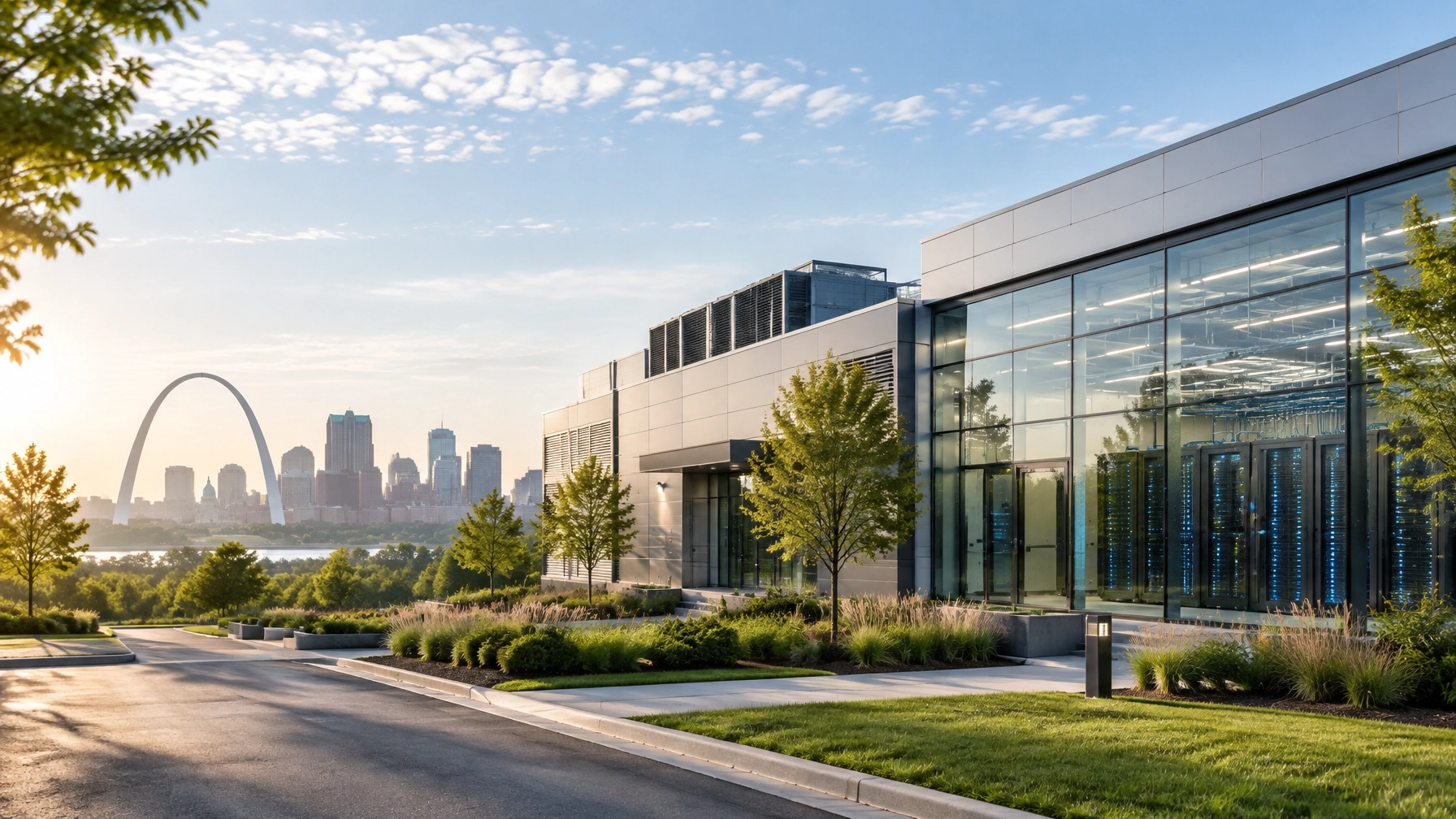
St. Louis is having a major technology moment this fall. New data center rules are taking effect. Franklin County is approving more data center development. Innovation Week is bringing AI and workforce education into the spotlight. And Chesterfield is hosting a leadership conference focused on preparing organizations for the age of AI.
That is encouraging.
But the practical question for you is simpler: What should your small business do differently now?
St. Louis tightens the rules around major data centers
On September 17, St. Louis Mayor Cara Spencer signed Board Bill 49, creating a dedicated regulatory framework for data centers.
The rules establish different requirements based on facility size and power use:
- Micro data centers must maintain a 150-foot setback.
- Standard data centers must maintain a 300-foot setback.
- Major data centers must maintain a 600-foot setback from homes, schools, parks, light rail stations, and transit centers.
- Data centers are prohibited in residential districts and local neighborhood commercial zones.
- Water-intensive evaporative cooling systems are prohibited.
- Major facilities must address noise, water infrastructure, grid capacity, and renewable energy use.
- Renewable energy requirements begin at 25%, increase to 50% by year five, and reach 100% by year ten.
The rules arrive as the region considers a proposed $3 billion data center project at the former Famous-Barr building in Midtown. The facility has been described as a 120-megawatt, AI-focused project.
Board Bill 55 also moved through the city process, prohibiting local tax incentives for data centers. The bill passed the Board of Aldermen on September 11, and the city record lists it as approved on September 18.
What does this mean for your business?
Not that your 15-person company needs to build a data center.
It means the St. Louis region is becoming a more serious technology and cloud infrastructure market. That may create more choices for cloud hosting, backup capacity, disaster recovery, connectivity, and technology partnerships.
But more capacity does not automatically create better protection.
You still need to ask:
- Where is your business data stored?
- How quickly could you recover after an outage?
- Are your cloud backups independent from your production systems?
- Can your provider restore a complete system, not just one file?
- What happens if your internet connection or cloud platform goes down?
If you have not reviewed those answers recently, now is a good time to revisit your cloud services strategy.
Franklin County is expanding the regional data center footprint
The growth is not limited to St. Louis city.
On September 15, the Franklin County Commission approved rezoning for two large data center projects: the Beltline or Crooked Creek campus south of Pacific and the Gateway Digital Campus near Villa Ridge and Gray Summit.
First Alert 4 reported that both projects involve large areas of land, billions of dollars in proposed investment, construction jobs, and significant infrastructure questions involving water, noise, roads, and nearby communities.
That matters to small businesses because regional infrastructure affects the options available to you.
You may eventually have more choices for:
- Cloud platforms and hosted applications
- Off-site backup storage
- Disaster recovery environments
- Business continuity services
- Secure remote work
- High-capacity connectivity
Here is the important distinction: infrastructure is the foundation, not the finished building.
You still need a plan for using that foundation securely.
Innovation Week signals that AI education is becoming practical business education
St. Louis Innovation Week launches in October as a new event organized by UMSL’s Mike Seper. It fills the gap left by STL Startup Week’s intentional pause and includes a hackathon, an innovation symposium, the Innovate USA Summit, and a free student showcase at the St. Louis Science Center.
Tickets start at $99, while the student showcase is free and open to the public. St. Louis Magazine’s coverage describes programming focused on geospatial technology, agtech, biosciences, workforce upskilling, and AI education.
Why should you care if you are not launching a venture-backed startup?
Because the organizers specifically describe the programming as relevant to small businesses.
Think about your own team. Could AI help summarize customer calls, organize documents, draft first versions of proposals, or reduce repetitive administrative work?
Possibly.
But could an employee also paste confidential customer information into an unapproved AI tool? Could an AI-generated email imitate your bank, vendor, or business partner? Could someone trust an inaccurate AI answer without checking it?
Also possibly.
The key is education.
Your team needs to understand:
- Which AI tools are approved for business use
- What information must never be entered into an AI system
- How to verify AI-generated content
- How to recognize AI-enhanced phishing and business email compromise
- Who owns the final decision when AI makes a recommendation
More tools require more judgment.

Chesterfield’s AI message applies directly to Main Street
From October 1 through 3, Chesterfield will host Human by Design: Thrive in the Age of AI at the Undivided Experience Center, 657 Spirit Airpark West, Suite 102.
The event features 22 speakers, is capped at roughly 75 founders and CEOs, and is headlined by Profit First author Mike Michalowicz.
Its central idea is worth taking seriously:
AI is not the disruption. Unarchitected leadership is.
In plain English, do not automate a process nobody owns and nobody understands.
Imagine your customer onboarding process. Three employees handle it differently. Information is stored in different places. Nobody knows who approves the final step. You add AI to “streamline” it.
What happens?
You may automate confusion.
Before you deploy AI, clarify:
- Who owns the process?
- What should happen first, second, and third?
- What information is required?
- What decisions need human approval?
- What happens when something goes wrong?
That is not just an AI lesson. It is good business management.
It is also good cybersecurity.
If an AI tool receives broad access to email, files, customer data, or financial systems, you need to know exactly what it can see and what it can do. Start small. Document the process. Limit access. Review the results.
The humans remain responsible.
Ransomware is increasingly about extortion, not just encryption
Here’s where the security conversation becomes more urgent.
Ransomware is no longer simply a matter of criminals locking your files and demanding money for a decryption key. Modern attacks may also involve stealing sensitive information and threatening to publish it.
That is extortion.
Recent regional incidents involving municipal services, transit, libraries, healthcare organizations, and educational institutions show how disruptive these attacks can be. The University City outage, for example, disrupted online city services for nearly a month. A separate incident involving Metro Transit included threats to release sensitive information.
A backup is still essential.
But a backup alone is no longer a complete ransomware strategy. That is why it helps to review both your ransomware protection for St. Louis small businesses approach and your data recovery services in St. Louis plan before an incident forces your hand.
You also need:
- Detection: Identify suspicious behavior before widespread damage occurs.
- Segmentation: Separate systems so an attacker cannot move everywhere at once.
- MFA: Protect email, financial systems, cloud platforms, and remote access.
- Least privilege: Give employees only the access they need.
- Protected backups: Maintain offline or immutable copies.
- Incident planning: Know who isolates systems, contacts insurance, and communicates with customers.
- Employee training: Make it easy for people to report suspicious messages quickly.

The message from the local cybersecurity conversation is straightforward: with AI in the mix, you are the intelligence.
Technology can identify patterns. It cannot replace your judgment about what your business values, what risks you can accept, or how your people should respond.
What you should do this fall
So, what can you do with all these headlines?
Start with a practical review, and if you want a stronger baseline, compare your current setup against this guide to Managed IT Services in St. Louis: 7 Things Your Provider Should Be Doing for You and this St. Louis Managed IT Services: A Deep Dive Into What Small Businesses Actually Get.
- Review your cloud and backup setup. Confirm what is protected, where copies are stored, and when restores were last tested.
- Require MFA everywhere it matters. Start with email, banking, payroll, administrator accounts, and remote access.
- Write down your core processes. Identify who owns them before you automate them.
- Set simple AI rules. Define approved tools, prohibited data, and human review requirements.
- Test your incident plan. Ask what happens if email, files, or accounting systems are unavailable tomorrow morning.
- Train your staff. Cover phishing, AI-generated messages, fake invoices, unusual payment requests, and suspicious login prompts.
That is the practical meaning of St. Louis’ technology investment.
The city can regulate data centers. Franklin County can approve new campuses. Innovation Week can teach emerging technologies. Chesterfield can bring leaders together.
But your business still needs its own plan.
Platinum Web Services provides St. Louis IT consulting, St. Louis cybersecurity, St. Charles County IT support, Chesterfield IT services, Clayton IT consulting, O’Fallon IT support, Metro East IT support, and Missouri managed IT services. Our solutions include cybersecurity solutions for small business, cloud services for small business, ransomware protection, data recovery, and 24/7 IT support.
Platinum Web Services
7827 Town Square Ave, 104-1184
O’Fallon, MO 63368
If you would like help reviewing your AI readiness, cloud strategy, or ransomware defenses, contact Platinum Web Services. A practical technology review can show you what to improve first.
Sources and further reading
- City of St. Louis: Board Bill 49
- City of St. Louis: Board Bill 55
- First Alert 4: Franklin County data center rezoning approvals
- St. Louis Magazine: Innovation Week
- Innovate USA
- Human by Design event information
- GovTech: University City cyberattack
SEO and social metadata
- Category: Blog
- Primary Rank Math focus keyword: St. Louis IT consulting
- SEO title: St. Louis Tech News: Data Center Rules, Innovation Week, and AI Readiness
- Meta description: St. Louis is investing in data centers and AI this fall. Here is what new infrastructure, Innovation Week, and ransomware trends mean for small businesses.
- Facebook/Open Graph title: St. Louis Tech News: Is Your Small Business Ready for the AI Shift?
- Facebook/Open Graph description: New data center rules, Innovation Week, Chesterfield AI leadership programming, and regional ransomware trends offer practical lessons for St. Louis small businesses.
- Facebook/Open Graph image: https://cdn.marblism.com/ah5_dVgoFA1.webp
- Facebook/Open Graph image dimensions: 1200×630
- Twitter card: Summary Card with Large Image
- Twitter title: St. Louis Tech News: Data Centers, AI, and Small Business Readiness
- Twitter description: What St. Louis data center growth, Innovation Week, and ransomware trends mean for your small business.
0 Comments