

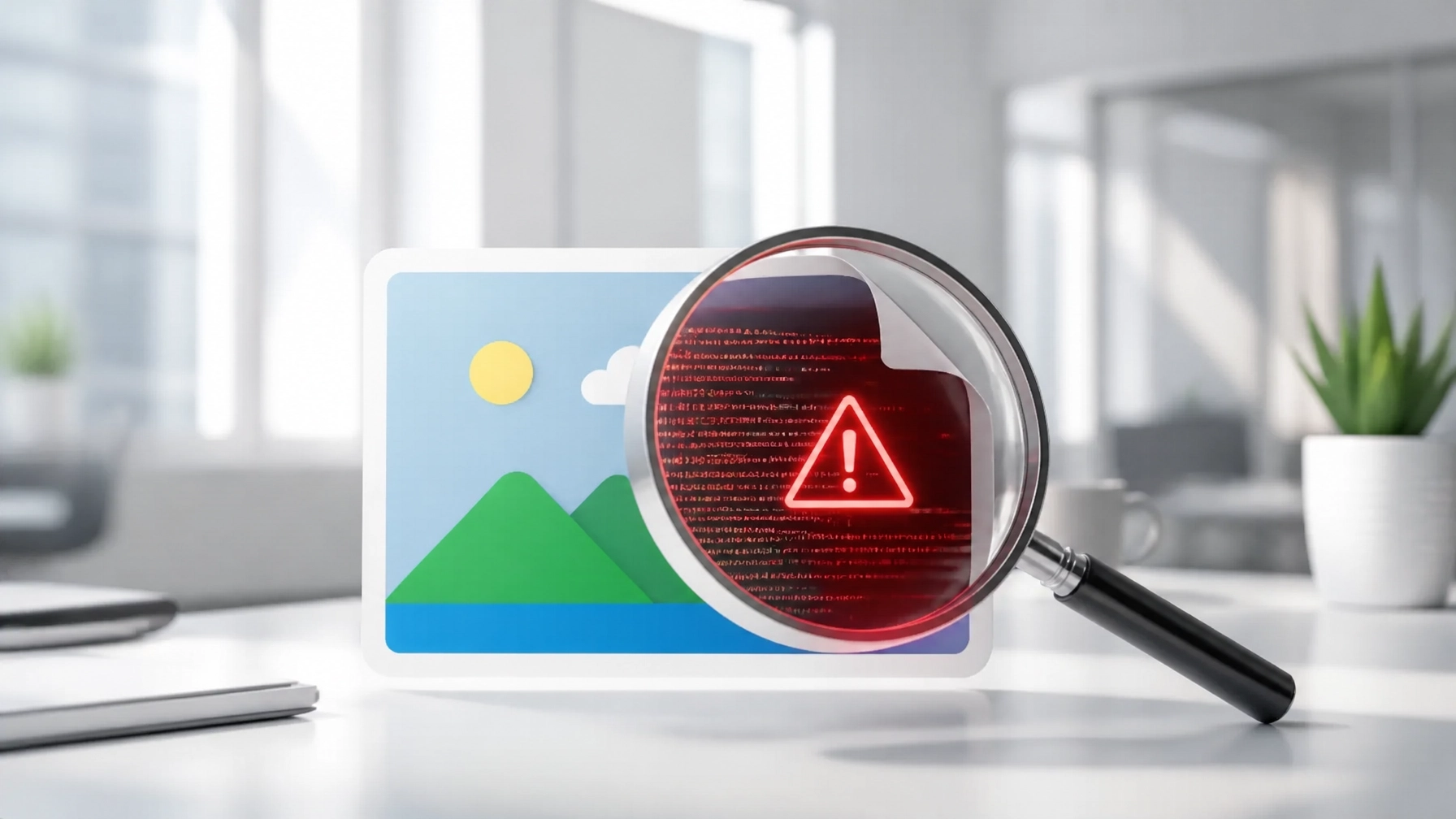
Let me ask you something: When was the last time you were afraid of a picture?
Not a scary movie or a creepy photo of a haunted house. I mean a standard, everyday image file sitting in your email inbox. Maybe it looks like a receipt, a delivery confirmation, or a "401k update" icon.
You wouldn’t think twice about clicking it, right?
After all, it’s just a picture. It’s not an "Exe" file or a suspicious "Zip" folder. It’s just a little bit of color and shape.
And that is exactly what hackers are counting on this June.
Welcome to the summer of SVG phishing, the most clever, invisible threat facing small businesses right now. While you’ve been busy worrying about AI-powered phishing bots, the bad actors have gone back to basics with a twist.
At Platinum Web Services, we’re seeing a massive surge in this specific attack. It’s sneaky, it’s effective, and if you aren’t prepared, it can hand the keys to your entire business over to a stranger in seconds.
The Wolf in Sheep’s Clothing (That's Actually a Website)
To understand why this is so dangerous, we need to talk about what an SVG actually is.
Most images, like the photos on your phone (JPEGs) or the logos on your website (PNGs), are made of pixels. They are "flat" files. Think of them like a printed photograph; you can look at it, but it doesn't do anything.
An SVG (Scalable Vector Graphic) is different.
Instead of pixels, an SVG is made of code. Specifically, it’s written in XML. It’s essentially a tiny, self-contained website that looks like a picture.
And because it's code, it can do things that a regular photo can't.
Imagine a "No Entry" sign on a door. A regular JPEG is like a sign painted on the wood. An SVG is like a sign that is secretly a touch-screen tablet. When you "look" at it (or open it), it can run programs, ask for information, or, in the case of phishing, redirect your browser to a malicious site.

Why This is the #1 Threat in June 2026
You might be wondering, "Why now?"
Hackers are like water; they always find the path of least resistance. For the last year, many cyber security solutions for small business have become very good at spotting suspicious links and dangerous attachments.
But most email filters still see an SVG as a "safe" image file.
The stats are, frankly, a little scary. In early 2026, SVG phishing campaigns jumped by nearly 50%. As of this month, June 2026, security researchers are seeing these files used as the primary way to bypass "CAPTCHA" gates.
Here is how the "aha" moment usually happens for a victim:
- You receive an email that looks 100% legitimate. It has your name and perhaps your correct company details.
- The attachment is an SVG. It might be named something like
Invoice_Copy_401k.svg. - You click it. Your browser opens a page that looks exactly like a Microsoft or Google login screen.
- It asks you to solve a CAPTCHA to "prove you’re human."
- Once you solve it, you’re prompted for your password.
Because you went through the CAPTCHA, your brain tells you the site is safe. But it isn't. The SVG file itself was the "hook" that dragged you to the hacker’s doorstep.
And just like that, your credentials, and potentially your business’s ransomware protection, are compromised.
Your 3-Step Action Plan to Stay Safe
At Platinum Web Services, we don't believe in scaring you without giving you a way to fight back. We specialize in proactive IT strategy, which means stopping the threat before it ever hits your screen.
Here is how you can protect your small business right now:
1. Block SVGs at the Gateway
If your business doesn't frequently exchange vector graphic files with clients (like a graphic design firm might), the simplest solution is to block them.
Most modern Secure Email Gateways can be configured to stop SVG attachments from ever reaching your employees' inboxes. Think of it like putting a filter on your front door that catches all the junk mail before it even lands on the mat.
If you aren't sure how to do this, that’s where managed IT support for small business comes in. We handle these configurations for our clients every day so they don't have to.
2. Move Beyond Simple Text-Code MFA
Most people use Multi-Factor Authentication (MFA) that sends a code to their phone. While that's better than nothing, it’s no longer enough in 2026.
Modern phishing sites can actually "intercept" those codes in real-time.
The gold standard now is phishing-resistant MFA. This includes things like FIDO2 security keys or biometrics (like your fingerprint or face scan). These methods require a physical "handshake" between your device and the server. Even if a hacker steals your password via an SVG image, they can't get past the physical security of your hardware.

3. Turn Your Staff Into a "Human Firewall"
Technology is only half the battle. The other half is awareness.
Most people don't click on bad links because they are reckless; they click because they are busy. They are trying to get through their to-do list and they trust their eyes.
Training your staff to recognize that any attachment, even an image, can be a threat is the most cost-effective phishing protection you can buy.
We recommend regular, "micro-training" sessions. Don't bore them with a two-hour lecture. Send them short, punchy updates about what's happening right now in the threat landscape.
It's About Peace of Mind
The truth is, you shouldn't have to spend your Sunday nights worrying about whether your employees are clicking on SVG files. You have a business to run.
That’s why Platinum Web Services exists.
We provide the "Platinum Shield", a proactive approach to IT where we manage your security, monitor your systems 24/7, and handle the updates before they become emergencies. Whether it's data recovery or setting up a robust cyber security strategy, we’re here to ensure your technology supports your growth instead of slowing it down.

Don't Wait for a Breach to Take Action
Cyber criminals aren't taking a summer vacation. In fact, with the rise of SVG phishing this month, they are working harder than ever to find a way into your systems.
Are you confident your current cyber security solutions are catching these hidden code threats?
If the answer isn't a resounding "Yes," let's talk. We help small businesses stay one step ahead of the hackers, providing the security and flexibility you need to scale without the stress.
Stay safe out there: and remember: sometimes a picture is worth a thousand stolen passwords.
Need help securing your small business against evolving threats? Contact Platinum Web Services today for a personalized IT strategy that puts your security first.

0 Comments