

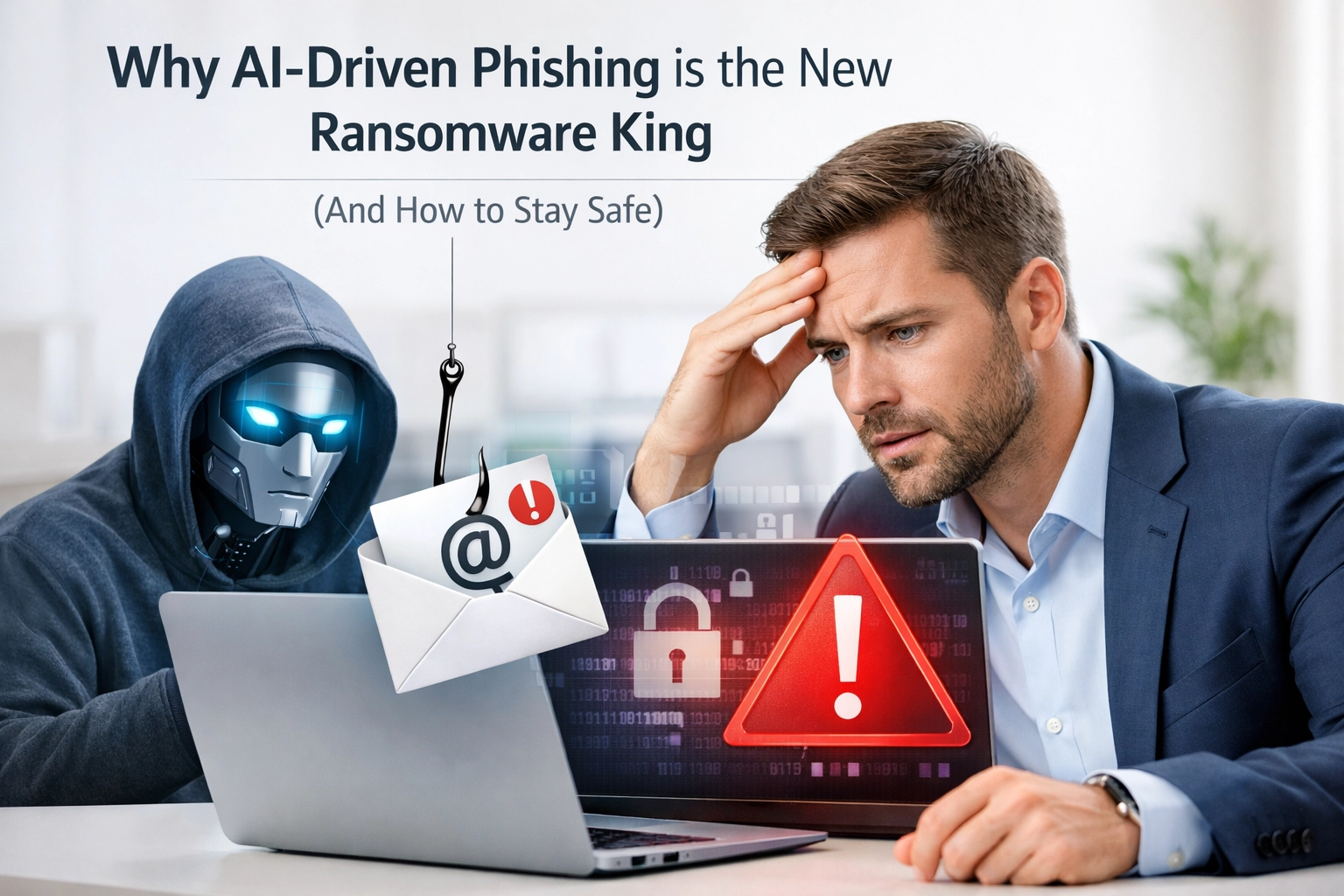
Let me ask you something: When was the last time you got an email from your "CFO" or a "vendor" that actually sounded exactly like them?
I’m talking about the right tone, the right inside jokes, and not a single "kindly" or misspelled word in sight.
You’re scanning your inbox on a busy Tuesday morning, trying to clear out the noise so you can actually get some work done. You see an email from a trusted partner about an outstanding invoice. It looks perfect. The logo is crisp. The link leads to what looks like a standard login page.
You click it. You’re busy, right? It happens to the best of us.
And just like that, the "Ironman" of hackers just walked through your front door without even breaking a sweat.
At Platinum Web Services, we’ve been watching the battlefield change rapidly over the last few months. If you think ransomware is still the biggest threat to your small business, I have some news that might keep you up a little later tonight.
Ransomware isn't the king anymore. It’s just the heavy-handed muscle. The real crown belongs to AI-driven phishing.
Here is why this shift is happening and, more importantly, how you can protect your business without feeling like you need a degree in computer science.
The Death of the "Nigerian Prince"
Remember the days when phishing emails were easy to spot?
They were riddled with bad grammar, weird spacing, and claims that you’d inherited millions of dollars from a distant relative you never knew existed. Those were the "Stone Age" of cybercrime.
Today, hackers have upgraded from clubs to laser-guided missiles.
By using Generative AI, cybercriminals have basically built their own version of J.A.R.V.I.S. to write their emails for them. They don’t need to know English. They don’t need to know your company culture. They just feed a few prompts into an AI tool, and out comes a perfectly crafted, highly persuasive email that would make a Madison Avenue copywriter jealous.
And the success rates? They are staggering.

Research shows that AI-generated phishing emails achieve a click-through rate of about 54%. Compare that to the 12% rate for human-written phishing messages. That is a 4.5x higher success rate.
Think about that for a second. More than half of the people who receive these AI emails are falling for them.
Why AI is the Ultimate Force Multiplier
In the tech world, we talk a lot about "scale."
For a hacker, scaling used to be hard. It took time to research a target, write an email, and set up a fake website. It might take 16 hours of manual labor to get a single convincing campaign ready to launch.
With AI, that time has been compressed to just five minutes.
That is a 95% reduction in operational costs for the "bad guys." It’s a complete game-changer. They can now send out thousands of unique, personalized emails in the time it takes you to finish your morning coffee.
Here’s another shocker: Phishing attacks linked to generative AI have surged by a massive 1,265% in the past year. We are now seeing a malicious email detected roughly every 19 seconds.
It’s an assembly line of digital destruction.
The "Polymorphic" Problem (And Why Your Filter Isn't Catching It)
You might be thinking, "Corey, I have a spam filter. Doesn't that catch this stuff?"
Well, yes and no.
Traditional security filters look for "signatures": specific patterns or known "bad" links that have been reported before. If a filter sees the same email being sent to 10,000 people, it flags it as spam.
But AI doesn't do "the same."
AI creates what we call "polymorphic" attacks. This means every single email sent out is slightly different. The wording is unique. The subject line is different. Even the links and file attachments are modified so they have unique digital "fingerprints" (hashes).
In fact, 76% of initial infection URLs are now unique, and 82% of malicious attachments carry unique file hashes.
Your traditional filter is looking for a specific face in a crowd. AI is giving every single attacker a different disguise. This makes it incredibly hard for standard cyber security solutions for small business to keep up without constant updates and human oversight.

Why Small Businesses are the Target
I hear this all the time: "Why would they target me? I’m just a small shop. They want the big fish, right?"
Actually, it’s the opposite.
The "big fish" have massive IT departments and sophisticated security operations centers. They are like Fort Knox. You, on the other hand, are likely focused on running your business, serving your customers, and keeping the lights on.
Hackers know that small businesses often have "good enough" security, which, in the age of AI, is the same as having no security at all.
They use AI phishing to get their foot in the door. Once they have a single set of employee credentials, they can move laterally through your network, steal your data, and then launch the ransomware.
Phishing is the key that unlocks the door. Ransomware is just what they do once they're inside your house and have their feet up on your coffee table.
How to Build Your Own "Ironman" Defense
So, is it all doom and gloom? Of course not.
But it does mean the old way of doing things: installing an antivirus and hoping for the best: is officially dead. You need a defense-in-depth strategy that treats your employees as a critical part of the armor, not just the "weakest link."
Here is how we help businesses at Platinum Web Services stay ahead of the curve:
1. Shift Your Focus to the Endpoint
We can't just rely on the "perimeter" (the wall around your network) anymore. Since AI can bypass filters, we need to monitor the "endpoints": the laptops, phones, and tablets your team uses every day.
If an employee clicks a link, we need tools in place that can detect the malicious behavior immediately and shut it down before it spreads. This is a core part of effective ransomware protection.
2. Human-Centered Detection
Since AI has eliminated obvious warning signs like typos, we have to teach our teams to look for context.
Does this request make sense? Why is the vendor asking for a wire transfer change via email? Why is the CEO asking me to buy gift cards at 7:00 PM on a Sunday?
We advocate for "controlled automation": combining smart AI detection tools with human validation. If something feels "off," it probably is.
3. Continuous Training (Not Just Once a Year)
A one-hour security video once a year is about as useful as a screen door on a submarine.
Organizations with ongoing security training see phishing click rates drop to as low as 1.5%. That’s a huge win. You want to turn your employees into a "human firewall." Encourage them to report suspicious messages. Make it a game, not a chore.

4. Zero Trust Architecture
The "Zero Trust" model is simple: Never trust, always verify.
Even if an email looks like it’s from your best friend, if it’s asking for sensitive data or access, the system should require multi-factor authentication (MFA) to proceed. MFA is one of the single most effective ways to stop a phishing attack in its tracks.
The Actionable Context: What You Should Do Today
If you're feeling a bit overwhelmed, don't worry. That’s why we’re here. You don't have to build the Ironman suit yourself; you just have to know who to call to help you put it on.
Here are three things you can do right now to improve your posture:
- Audit Your Credentials: Check if your team is using the same passwords for multiple accounts. Use a password manager and turn on MFA for everything.
- Check for Known Vulnerabilities: Cybercriminals love to use "known" holes in software to get in. Check out the latest CISA Advisories to see what needs patching in your environment.
- Get a Security Assessment: If you aren't sure where you stand, let us take a look. We help small businesses identify where their "windows are left open" before the bad guys do.
The truth is, the threat landscape in 2026 is faster and smarter than ever before. But by staying informed and using the right tools, you can keep your business safe and focus on what you do best.
If you’re tired of worrying about whether your IT support is actually keeping you safe, maybe it’s time for a change. Check out our guide on 10 reasons your current IT support isn’t working to see if you’re getting the protection you deserve.
Stay safe out there. And remember: if that email looks too perfect, it probably is.
We help businesses like yours with this every day. If you’d like to chat about securing your team against AI-driven threats, get in touch with us at Platinum Web Services. We’d love to be your partner in this fight.
0 Comments