

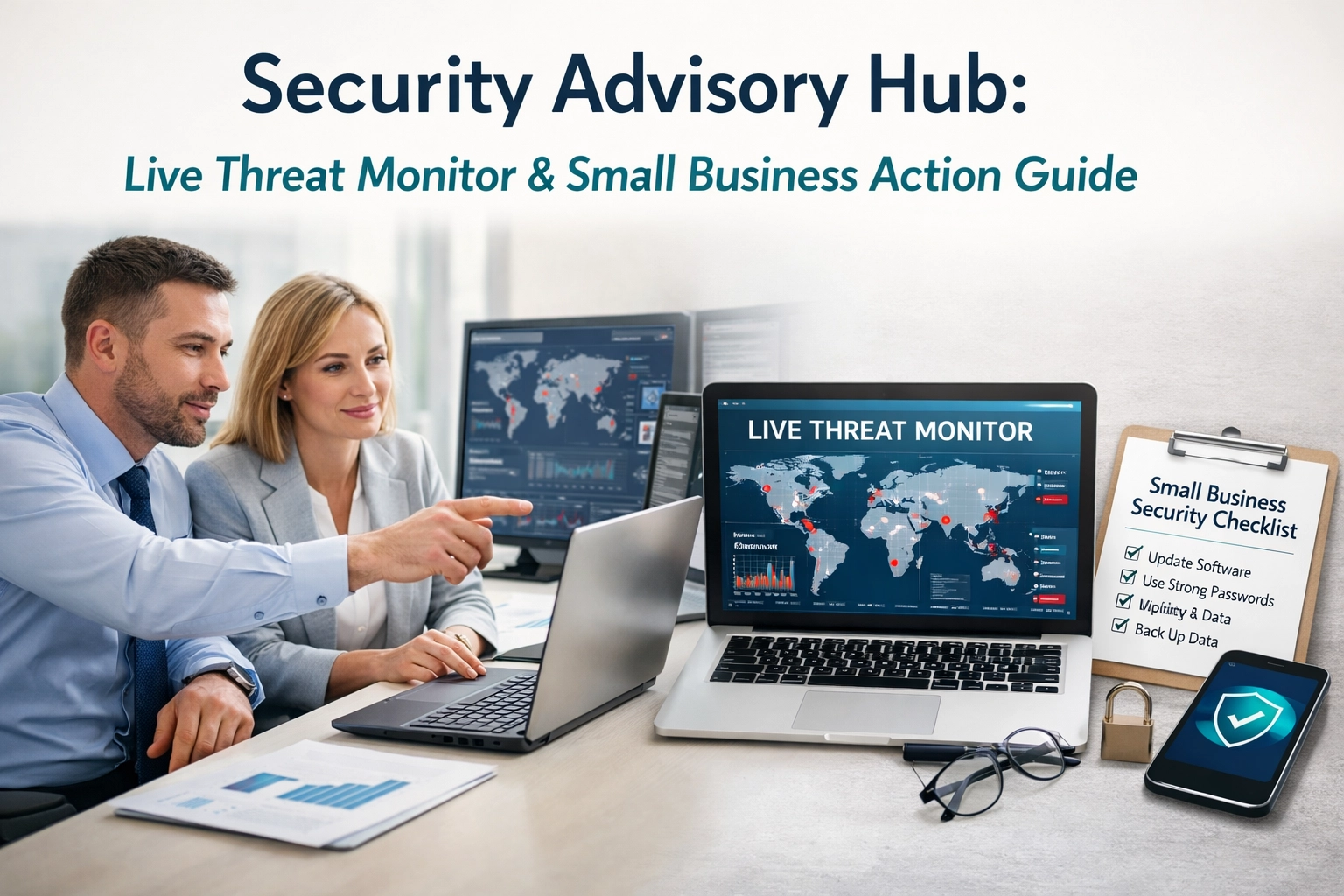
Let me ask you something: if someone tried to break into your business today, would you even know where they’d start?
Welcome to the Platinum Web Services Security Advisory Hub.
This is the short, practical version: the core threat areas we’re seeing in this June 2026 update, the specific June 2026 CISA “patch now” items to pay attention to, and a 5-step action plan you can run this week.
Threat Overview: The 3 Risk Areas That Hit Small Businesses Hard
1. Edge Device & Remote Access Vulnerabilities
Tools that sit on the “edge” of your network: VPNs, firewalls, remote access gateways, and management appliances: are a favorite target.
Think of these as the gates to your fortress. Here’s the problem: If attackers find a weakness there, they can slip past the front door without triggering any alarms. It’s like someone getting a master key to the building. From there, they move quietly, steal data, and often set the stage for ransomware.
And here’s where it gets scarier: newer ransomware crews are getting more aggressive about how they spread once they land. The Gentlemen ransomware is a prime example, and Silent Ransom Group is another name small businesses should be watching closely this June. Research shows these threat actors can use SMB (the file-sharing protocol Windows uses on local networks) along with SYSTEM-level scheduled tasks and services to move laterally and execute with high privileges. In plain English, that means one infected machine can become a launch point for the rest of your environment if your internal controls are weak.
2. Mobile & Operating System Exploits
You probably trust your laptop and phone. Most people do. You use them for banking, email, and managing your entire business.
But operating systems like Windows and macOS, and mobile platforms like iOS and Android, get exploited all the time. Sometimes it’s a “zero-day” (meaning the vendor didn’t have time to prepare a fix before it started getting abused). Sometimes it’s simply an update that didn’t get installed because it was "inconvenient." Either way, it can lead to device takeover, credential theft, or malware.
And here’s another June reality: attackers are also leaning harder into AI-powered Business Email Compromise (BEC). That means more convincing fake invoices, more believable executive impersonation, and more email scams that sound just real enough to get a quick reply or payment approval.
3. Server & Virtualization Risks
If you run servers: whether they are sitting in a closet or hosted in the cloud: remote code execution (RCE) is one of the scariest phrases you can hear.
RCE means an attacker can run commands on a server from the outside, just like they’re sitting at your keyboard. If that layer isn’t patched and segmented properly, your entire environment can become a playground for cybercriminals.

Small Business Impact: Why Should You Care?
I know what you’re thinking. "Look, I run a 20-person accounting firm (or a construction company, or a medical clinic). Why would a high-tech hacker care about me? Shouldn't they be going after the big banks?"
It makes sense to think that. But here’s the reality: You are the perfect target.
Big banks have "Fort Knox" levels of security. They have teams of hundreds of people watching their screens 24/7. You? You’re busy running a business. You might have one "IT guy" who comes in once a month, or maybe you're doing it all yourself.
To a hacker, your business is "low-hanging fruit." They don't need a million dollars from one bank when they can get $50,000 from twenty small businesses who don't have their managed IT services in order.
The "Snowball" Effect
When one of these vulnerabilities: like the Ivanti or Apple exploits: hits your business, it doesn't just stop at one computer. It cascades.
- Day 1: One employee clicks a link or an unpatched VPN is exploited.
- Day 2: The hacker scans your network for passwords and admin credentials.
- Day 3: Your customer list and financial records are uploaded to a dark-web forum.
- Day 4: You walk in Monday morning to find every computer screen flashing a ransom note.
This isn't just a "tech issue." It’s a business-ending event. The truth is, a huge percentage of small businesses that suffer a major data breach never recover. They close their doors within six months.

The Platinum Shield: Proactive Defense (Without the Guesswork)
At Platinum Web Services, we don’t believe in "waiting for things to break." That’s the old way of doing IT, and quite frankly, it’s dangerous. It’s like waiting for your engine to explode before you check the oil.
We use what we call The Platinum Shield. It’s our proactive strategy designed to reduce risk, prevent downtime, and keep your business protected day in and day out.
Clear Standards & Security Baselines
Instead of chasing constant “live alerts,” we focus on what consistently stops real-world attacks. We look at the basics first. If your basics are strong, the advanced threats have a much harder time getting through. This includes:
- Keeping systems patched on a schedule you can verify.
- Locking down remote access so only authorized users can get in.
- Reducing admin privileges (not everyone needs the "master key").
- Standardizing secure configurations across all devices.
- Training your team to spot scams before they click.
Automated Patching & Hardening
While you’re sleeping, our systems are pushing out updates. We "harden" your network, closing the digital windows and double-checking the locks.
If you're wondering why your current IT support isn't doing this, you might want to check out our post on 10 reasons your current IT support isn't working. Hint: If they are reactive instead of proactive, they are leaving you exposed.
Human Intelligence
Software is great, but it’s not enough. Our team of experts analyzes every high-level threat to see how it specifically impacts your unique setup. Whether it’s ransomware protection or securing your remote workers, we tailor the shield to fit your business.
Live Threat Monitor: CISA Alerts for Small Business
You don’t have time to live on security bulletin sites. That’s the point. You have a business to run. We monitor these alerts 24/7 so you don't have to.
Here are the latest CISA Known Exploited Vulnerabilities (KEV) items reflected through June 3, 2026, explained in plain English:
Recent KEV Alerts (Updated June 3, 2026)
-
Oracle WebLogic Server — CVE-2024-21182
Added June 1, 2026. This one affects Oracle WebLogic Server and matters because internet-facing application servers are a favorite target. If your business or software vendor still relies on WebLogic, this is the kind of server-side weakness that can open the door to unauthorized access and deeper compromise. -
Android Framework — CVE-2025-48595
Added June 3, 2026. This Android Framework flaw is a reminder that phones and tablets are business devices too. Reports point to active abuse, and a vulnerable Android device can become the starting point for credential theft, surveillance, or follow-on compromise. -
Linux kernel — CVE-2022-0492
Added June 3, 2026. This Linux kernel issue has been tied to privilege escalation, especially in environments using containers. In plain English, if an attacker gets a foothold on the wrong Linux system, this kind of flaw can help them break out, escalate privileges, and take control of more than they should. -
Windows Netlogon — CVE-2026-41089
Active exploitation warning. If your environment uses Windows domain controllers, pay attention. Netlogon issues can hit the heart of identity and authentication inside your network. That means one successful exploit can quickly turn into a much bigger business problem. -
Citrix NetScaler — CVE-2026-3055
Active exploitation warning. This affects Citrix NetScaler ADC/Gateway devices, which often sit right on the edge of the network. That makes it especially dangerous. If the edge is exposed, attackers may not need much else to start moving inward.
What to do: Prioritize any internet-facing systems first: Citrix NetScaler, Windows domain infrastructure, and Oracle WebLogic should move to the top of the list. Then review Android devices used for business access and any Linux servers or container hosts that may still be behind on patches. If it faces the internet or touches sensitive business data, treat it as urgent.
Quick-Patch Checklist: Your 5-Step Action Plan
Even if you aren't a Platinum Web Services client yet, we want you to be safe. If you're managing your own IT or want to double-check your current provider, here is your "Quick-Patch Checklist" for this month:
- Patch Citrix NetScaler and Windows Netlogon First: If you use Citrix NetScaler or run Windows domain controllers, treat CVE-2026-3055 and CVE-2026-41089 as urgent because both come with active exploitation warnings.
- Review Oracle WebLogic Exposure: If you or one of your software vendors still uses Oracle WebLogic Server, treat CVE-2024-21182 as a priority. Internet-facing app servers should never sit in the "we'll get to it later" pile.
- Update Android and Linux Systems: Review company-managed phones, tablets, Linux servers, and container hosts for CVE-2025-48595 and CVE-2022-0492 exposure. Mobile and Linux issues are not just "enterprise" problems anymore.
- Disable or Secure SMB Ports (TCP 445): This matters more than ever. Restrict SMB exposure internally and externally to help block worm-like propagation tied to threats like WantToCry and The Gentlemen.
- Check Your Backups: If a patch fails or a hacker gets in, your backup is your last line of defense. Is it "Air-Gapped" (disconnected from the main network)? If not, the hacker will delete your backups first. Learn more about the truth of cloud backups.
- Review the Known Exploited Vulnerabilities (KEV) catalog: Take five minutes to look at the CISA KEV Hub. If you see software you use on that list, you are at high risk.
The Truth Is…
Most compromises don’t start with a movie-style hacker scene.
They start with one of three things: an exposed edge device, an unpatched OS, or a vulnerable server.
And here's another reminder: security is not just digital. Recent warnings about the Silent Ransom Group show that some attackers are willing to go beyond phishing emails and remote access tricks. In some cases, they have used in-person USB drop tactics to get a foothold inside a business. That means front-desk awareness, visitor verification, and device control policies matter just as much as patches and firewalls.
If you want help confirming what you’re running (and whether it’s exposed), we can help you build a proactive strategy that keeps patching, access control, and backups handled without the scramble.
Stay safe out there.

0 Comments